
Pad Printing vs. Screen Printing: How to Choose the Right Process for Your Part

If you're adding a logo, part number, or graphic to a product, you've probably run into this question: should it be pad printed or screen printed? Both are proven, both are used across medical, industrial, and consumer manufacturing, and both can produce a sharp, durable print.
The short answer is that it mostly comes down to your part. Pad printing is usually the better choice for small, curved, textured, or irregular surfaces. Screen printing usually wins on larger, flat or cylindrical surfaces where you need a bold, opaque layer of ink.
Below, we'll walk through how each process works, where each one shines, and the questions worth asking before you commit to one.
How Each Process Works
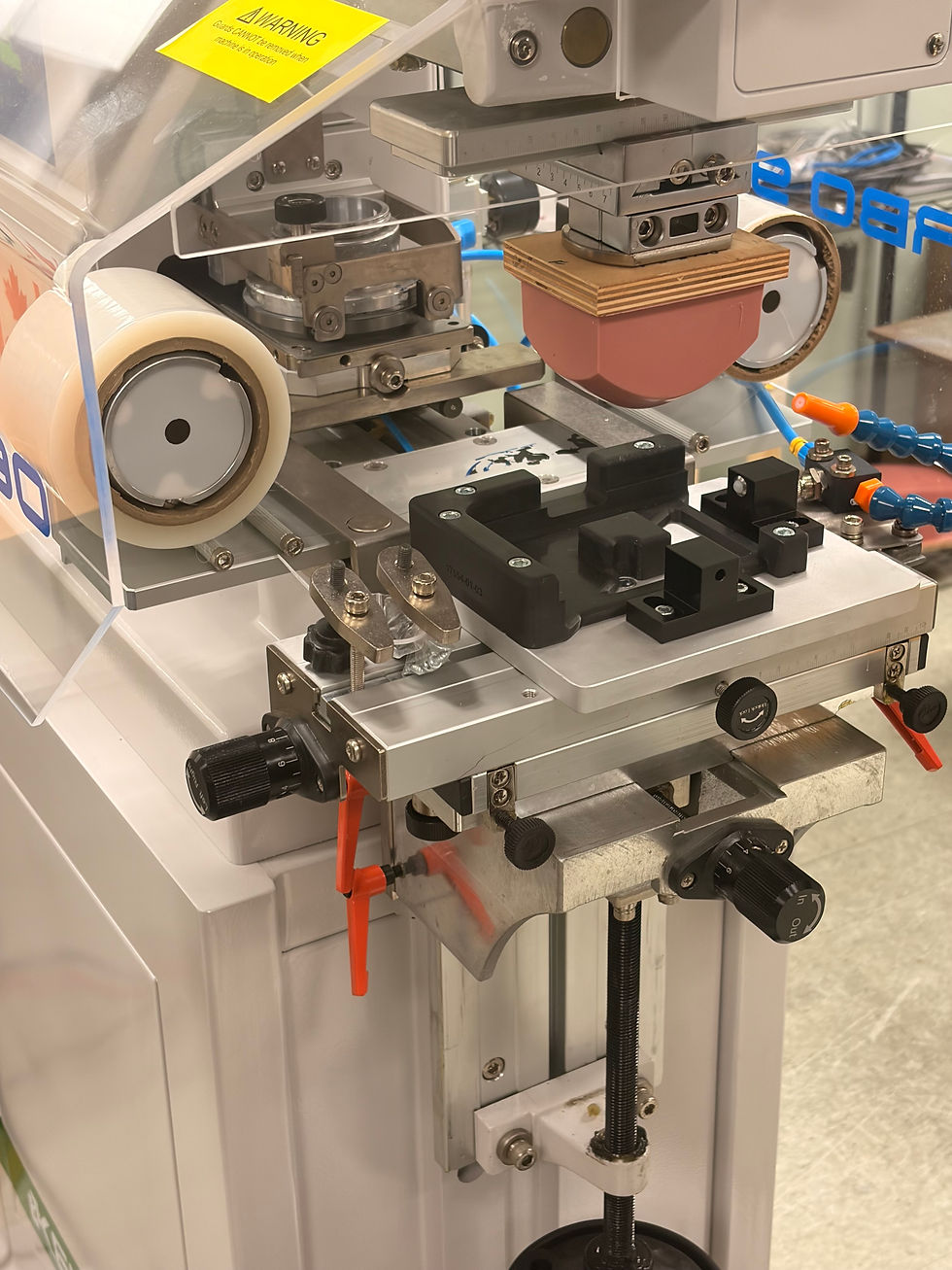
Pad printing starts with an etched plate, called a cliché, that holds your artwork. Ink fills the etched image, a soft silicone pad presses down to pick it up, and then the pad presses onto your part to transfer the image. Because the pad flexes, it can wrap around curves, reach into recesses, and print on uneven surfaces that a flat stencil can't touch.
Screen printing pushes ink through a fine mesh screen with a squeegee. The screen is blocked everywhere except your design, so ink passes through only where you want it. The result is a thicker layer of ink than pad printing, which gives you strong color, good opacity, and excellent durability on flat or evenly curved parts.
Pad Printing vs. Screen Printing at a Glance
Pad Printing | Screen Printing | |
Best surfaces | Curved, textured, recessed, irregular | Flat or evenly cylindrical |
Print area | Small to medium (<2mm-160mm for standard machines - Up to 800mm wide on sideways configuration) | Medium to large |
Detail | Very fine lines and small text | Good detail, better for bolder graphics |
Ink layer | Thin | Thick |
Opacity | Good | Excellent, especially on dark parts |
Multi-color | Can print colors in quick succession | Each color usually needs its own screen and pass |
Common uses | Medical devices, buttons, keypads, pens, caps, electronics | Bottles, panels, signage, containers, larger flat parts |
When Pad Printing Is the Better Fit
Pad printing makes sense when your part shape would give a screen trouble. Think molded plastic components, rounded caps, instrument handles, or anything with ridges, dips, or edges near the print area.
It's also a strong choice when you need fine detail in a small space. Tiny text, tight logos, and markings on medical and electronic parts are classic pad printing jobs. And because the ink layer is thin, you can print multiple colors close together without long waits between passes.
When Screen Printing Is the Better Fit
Screen printing is the go-to when you need coverage and punch. If you're printing a large graphic on a flat panel or wrapping a design around a bottle, screen printing lays down more ink in one pass than a pad can.
That thicker ink layer also matters for opacity. If you're printing white or a light color on a dark part, screen printing usually gives you a cleaner, more solid look. It's also a good fit when the print needs to stand up to heavy handling or outdoor exposure.
Questions to Ask Before You Decide
What does the print surface look like? Curved, textured, or recessed points toward pad printing. Flat or smooth cylindrical points toward screen printing.
How big is the print area? Small marks favor pad printing. Larger graphics favor screen printing.
How much detail is in the artwork? Fine lines and small text are easier to hold with a pad.
What color is the part, and what color is the ink? Light ink on dark parts often needs the opacity screen printing provides.
What material is the part made of? Plastics, metals, glass, and coated surfaces can all behave differently, and the ink needs to match.
What volume are you running? Your production numbers affect whether a manual, semi-automatic, or fully automated setup makes sense.
If your answers are split, that's normal. Plenty of manufacturers use both processes, choosing part by part.

Frequently Asked Questions
Is pad printing or screen printing more durable?
Both can be very durable when the right ink is used for the material. Screen printing lays down more ink, which can help in high-wear or outdoor applications.
Can pad printing print on curved surfaces?
Yes. That's one of its biggest strengths. The silicone pad flexes to match the shape of the part.
Can screen printing print on round objects?
Yes, on evenly cylindrical parts like bottles and tubes. It struggles more with irregular shapes, tight curves, and recesses.
Which process is better for small parts?
Pad printing is usually the better choice for small parts and small print areas, especially when the detail is fine.
Can I use both processes in the same facility?Yes. Many manufacturers run both so they can match the process to each part rather than forcing every job into one method.
Not Sure Which Is Right for Your Part?
At DPT, we work with both pad printing and screen printing every day, from equipment and supplies to fully automated decoration systems. If you're weighing your options, send us your part and your artwork. We'll help you figure out which process fits, and we can run sample prints so you can see the results before you commit.


Comments